Artificial Intelligence and Artists’ Intellectual Property: Unpacking Copyright Infringement Allegations in Andersen v. Stability AI Ltd.
centerforartlaw posted: "By Sophia Williams "We've filed a lawsuit challenging AI image generators for using artists' work without consent, credit, or compensation. Because AI needs to be fair & ethical for everyone."[1] – 'Stable Diffusion Litigation' (website created by at"
"We've filed a lawsuit challenging AI image generators for using artists' work without consent, credit, or compensation. Because AI needs to be fair & ethical for everyone."[1] – 'Stable Diffusion Litigation' (website created by attorneys on behalf of the artists)
"If a work is transformative…then it's not a violation of copyright and the plaintiff simply has no ground on which to stand to file a copyright infringement case…[T]hose who refuse to acknowledge advancements in technology and instead fight against them are like whittlers mad at power tools."[2] – 'Stable Diffusion Frivolous' (website created by tech enthusiasts defending AI image generators)
On January 13, 2023, three visual artists filed a putative class action suit against three AI companies in the Northern District of California, on behalf of themselves and other artists. Sarah Andersen, Kelly McKernan, and Karla Ortiz challenge the defendants' use of images of their artwork, registered with the U.S. Copyright Office, in the development of AI image generators.
The companies, Midjourney est. 2021, Stability AI est. 2019, and DeviantArt est. 2000, create platforms that produce AI-generated art in a matter of seconds in response to users' custom text prompts and directives. Alleging several issues with the initial complaint, these companies each filed separate motions to dismiss, and on October 30, 2023, a U.S. District Court Judge William H. Orrick issued an order that found that the complaint was "defective in many respects" and largely granted the defendants' motions.[3] However, as is usual, the judge gave the artists and their legal teams "leave to amend to provide clarity regarding their theories of how each defendant separately violated their copyrights, removed or altered their copyright management information, or violated their rights of publicity and plausible facts in support."[4] Matthew Butterick, an attorney for the artists alongside Joseph Saveri noted that the judge "sustained the plaintiffs' core claim pertaining to direct copyright infringement" and expressed optimism in the claim's path to trial and the ability to address the court's concerns.[5]
On November 29, 2023, the artists and their legal team submitted an amended complaint, 94 pages to the original complaint's 44, adding seven artist-plaintiffs: Gerald Brom, Adam Ellis, Julia Kaye, Gregory Manchess, Grzegorz Rutkowski, Hawke Southworth, and Jingna Zhang. Runway AI est. 2018 was also added as a fourth defendant.
The amended complaint includes arguments and a high-level overview of the technical process through which AI platforms allegedly source the plaintiffs' copyrighted material to create output images that are strikingly similar and stylistically reminiscent to their own, creating images arguably indistinguishable from the artist's copyrighted intellectual property—without authorization from the artists or compensation for them. The plaintiffs charge the defendants with 17 counts in total; however, this article will focus specifically on the charges of direct copyright infringement, which account for 5 of the counts alleged. Direct copyright infringement charges represent a key element of the plaintiffs' argument that the conduct of the named AI companies is unlawful. The article will explore the legal arguments plaintiffs offer, and potential counterpoints.
No matter the outcome, the case aims to provide clarity around whether ethical considerations of sourcing immense amounts of copyrighted material—instrumental in training in AI image generators—cross the line into unlawful conduct. Midjourney's CEO discussed the company in comments, explaining that the company is trained on "a big scrape of the internet"—an enormous scope of data, including visual material, and artists' creative expression.[6] When asked about the "'ethics of massive copying of training images,' he said, 'There are no laws specifically about that.'"[7] Therefore, new case law will be impactful, given the present lack of specific laws about how AI capabilities may permissibly interface with copyrightable data such as visual images and artworks. This case will thus provide much-needed direction and will continue to be closely monitored by any with stakes in the intersections of arts, technology, and law.
Alleged Copyright Infringement of AI-Generated (OUTPUT) Images
The amended complaint brings claims of direct copyright infringement on behalf of the artists, who allege that Stability AI, Midjourney, DeviantArt, and Runway unlawfully appropriated protected works. The original complaint submitted in January 2023 alleged the companies violated the Copyright Act (17 U.S.C. § 501) by unlawfully inputting copyrighted material to train its AI models and outputting images that are derivative of the protected material.
First, we'll look at the alleged copyright infringement occurring at the output level. Some of the user-facing AI platforms relevant to this case include Stability's DreamStudio and Reimagine XL, Runway's AI Magic Tools, and DeviantArt's DreamUp, all released between 2022 and 2023.[8] Users may enter a text prompt describing what image they'd like to see the AI product generate, and after an approximate 60-second wait, will receive a few digital images illustrating their instructions. Below are a series of output images generated by the author, using DreamUp, beginning with entering the text prompt, "painting of the Brooklyn Bridge in winter," which generated a perfectly lovely, snowy scene reminiscent of the style of digital art often generated by AI prompts.
Credit: DreamUp generated output image; text prompt: "Painting of the Brooklyn Bridge in winter."
The platforms also allow users to enter text prompts that request the output image to be in a certain genre, or in the style of a specific artist. According to the complaint, in Midjourney's "tips for text-prompts," the company recommended users "'try invoking unique artists to get a unique style,' and offered a list that included 'Greg Rutkowski,'" one of the artist plaintiffs in the case.[9] Subsequently, two weeks after the initial complaint was filed, Midjourney removed this language from its website.[10] The complaint also argues that "executives and high-level employees of Stability know that one of the most attractive features of the Stability models is its ability to mimic and copy artists' works, including Plaintiffs. As such, they routinely advertise the Stability Models' ability to mimic artwork."[11]
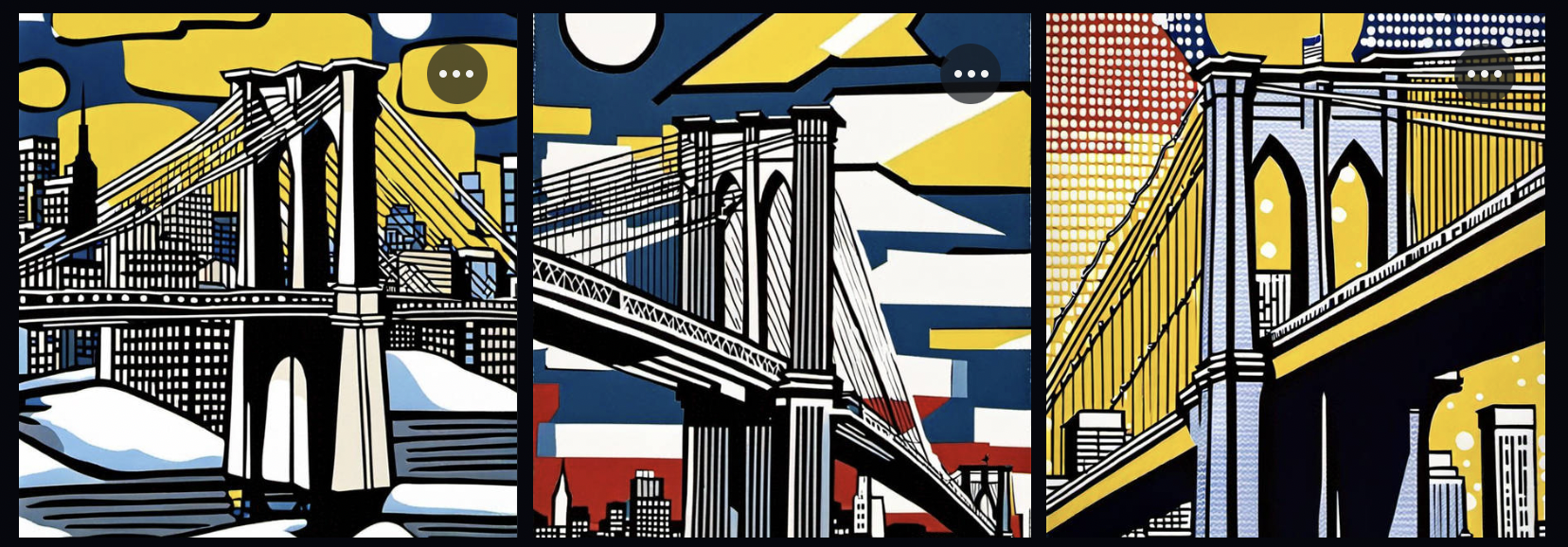
Next, the author entered the text prompt "Painting of the Brooklyn Bridge in winter in the style of Roy Lichtenstein," which produced images with the bright primary reds and blues and swaths of polka dots and stripes characteristic of Lichtenstein's pop art. The next text prompt the author entered, "painting of the Brooklyn Bridge in winter in the style of Andy Warhol" added some pastel oranges and pinks reminiscent of a Warhol-color palette, and rendered the Brooklyn Bridge scenes with loose, streaking marks as if it had been drawn by hand.
Credit: DreamUp generated output image; text prompt: "Painting of the Brooklyn Bridge in winter in the style of Roy Lichtenstein."
Credit: DreamUp generated output image; text prompt: "Painting of the Brooklyn Bridge in winter in the style of Andy Warhol."
When the author entered the text prompt, "tomato soup cans in the style of Andy Warhol," DreamUp outputted a series of images evoking the iconic Campbell's cans and logo, even though the author did not input Campbell's name in the prompt. This output image is strongly evocative of Warhol's painting, Campbell's Soup Cans (1962), a protected piece of intellectual property. Nevertheless, AI image generators do not have a process in place to recognize the exclusive rights of the copyright owners, in this case, the Andy Warhol Foundation, to reproduce, share, and create derivative works from the original painting.
Credit: DreamUp generated output image; text prompt: "tomato soup cans in the style of Andy Warhol".
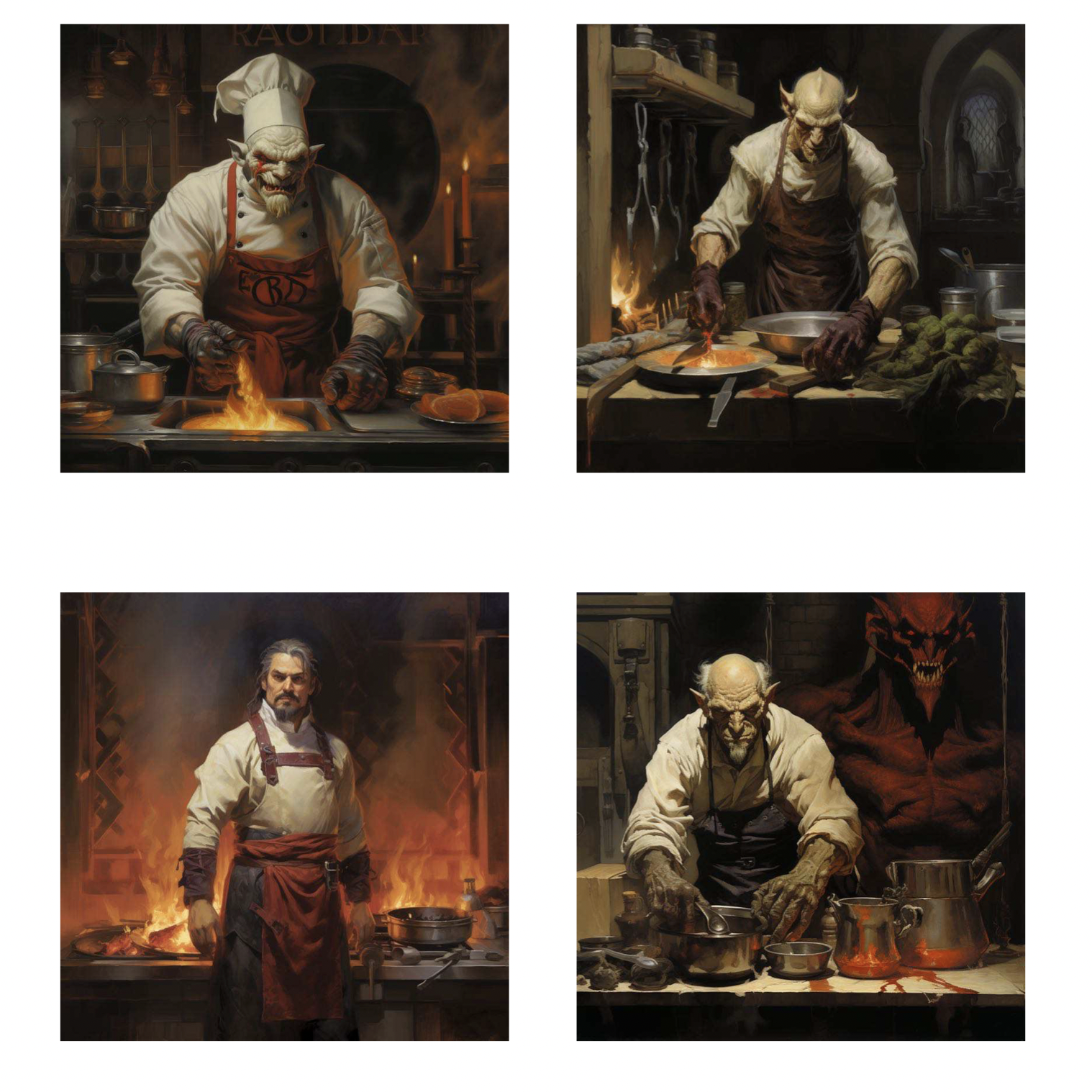
The plaintiffs take issue with the platform's capacity to enable users to generate artworks in the style of their work. The amended complaint includes appendices with examples of outputs generated by users requesting an image in the style of the artists who are plaintiffs in this lawsuit. For example, the complaint includes an output Midjourney creates in response to the prompt, "chef," and again in response to the prompt, "gerald brom chef."[13] The former generates some standard-looking chefs with appropriate kitchen garb, while the second generates images of chefs as fantastical, bulky, monstrous demons in the kitchen, closely emulating Brom's artworks and character designs.[14] As the complaint reads, "Gerald Brom is known for gritty, dark, fantasy images, painted in traditional media, combining classical realism, gothic and counterculture aesthetics," and the AI output image certainly captures the likeness of Brom's signature style.[15]
Midjourney generated output image; text prompt: "chef;" included in Exhibit F in amended complaint.
Midjourney generated output image; text prompt: "gerald brom chef;" included as p.3 in Exhibit F: Mid journey text prompts in amended complaint.
Furthermore, the complaint puts forth evidence for not only the AI companies' knowledge of the capacity of the output images to mimic artists' styles, but also their dedicated advertising and promotion of this capacity. Around the release of Midjourney's image-generating AI product, Midjourney's CEO David Holz posted publicly on Midjourney's discord server.[16] In the messages, Holz says, "i think you're all gonna get [your] mind blown by this style feature ... we were very liberal in building out the dictionary ... it has cores and punks and artist names ... as much as we could dump in there ... i should be clear it's not just genres its also artist names ... it's mostly artist names ... 4000 artist names."[17] This quote exemplifies the designed nature of AI platforms to create works that do not incidentally mirror the works of human artists, but intentionally function as tools for users to create, in seconds, images that closely resemble the stylistic identities of the artists who've originally conceptualized them as if the artists themselves have created an image for the user of a "chef" or the "brooklyn bridge in winter," whatever the user requests.
As the plaintiffs argue, instead of commissioning an to create a work, or paying for a print or license of the work, now users simply prompt an AI image generator to create an artwork in the style of a specified artist – one that is"indistinguishable from one the artist might've created themselves."[18] An interesting point the complaint notes is that artist Kelly McKernan "was astonished to find that the top internet search result for their name is now an AI-generated image made with Midjourney, prompted with Mx. McKernan's name."[19] Not just an idea but a reality that's producing concrete effects such as this, image generators to create outputs that are similar to, and mistaken for original artist's work.
Source: Amended Complaint: Top internet search of artist Plaintiff Kelly McKernan is AI generated.
To allege direct copyright infringement, the plaintiffs must sufficiently prove unlawful appropriation and copying.[20] The material the AI image generators have based these output images on is protected work. All of the artists who are plaintiffs in the case have registered their works with the U.S. Copyright Office. The output images generated by the image generators bear a striking similarity to the works the artists produced. One could argue that AI outputs would not exist if not for the artists' creations. At a glance, the image of Midjourney generated, of the "gerald brom chef", for example, has clear roots in Gerald Brom's work, it's a form of a copy. It derives from Brom's artistic identity and production, and his copyrighted artworks—protected expression.
According to the complaint, this resemblance is problematic and unlawful, and the argument for the AI companies' copyright infringement is stated through the following claims: "[d]efendants had access to but were not licensed by Plaintiffs nor the Class to create Derivative Works based upon the Works" and "[d]efendants had access to but were not licensed by Plaintiffs nor the Class to incorporate the Works into the products offered by Stability, DeviantArt, Midjourney, or related software applications."[21]
On the other hand, AI companies disagree with the conclusion that the AI outputs bear substantial similarities to the artists' protected works. According to Stability's motion to dismiss, the images the AI platform output are not at all direct copies of the artists' work, nor meet the standard of being substantially similar.[22] The amended complaint notes the questions of law expected to arise in the case and anticipates a question related to the AI companies' expected defense, of "whether any affirmative defense excuses Defendants' conduct, including whether some or all of Defendants' conduct is allowed under fair use."[23]
Fair use is an affirmative defense that may be used "in response to claims by a copyright owner that a person is infringing a copyright."[24] There is no steadfast set of conditions that determine that one's use of a copyrighted work without permission of the copyright owner constitutes fair use, and determining fair use occurs on a case-by-case basis.[25] However, copyright law outlines four factors that are considered when assessing if the use of copyrighted work is fair use.[26] These factors include
the purpose of the use, such as whether the use is for profit;
the nature of the copyrighted work, such as whether the original work was more creative than factual;
the degree to which the substance of the copyrighted work was used; and
the effect of the use on the market for the original copyrighted work.[27]
According to the AI companies, the substance of the copyrighted works differs from AI-outputted images. Unlawful appropriation requires a plaintiff to allege that there are "substantial similarities" between the allegedly copied and allegedly infringing works.[28] As argued in Stability's motion to dismiss, filed in April 2023 after the initial complaint in January, the artists' output-image-based allegations do not meet this standard.[29] According to the motion, "[p]laintiffs fail to identify a single allegedly infringing output image, let alone one that is substantially similar to any of their copyrighted works."[30] In other words, AI companies point to the fact that the output images are, by definition of the process of AI-led creation of an image, always different images from the artists' copyrighted works. They point out that the artists have admitted as much.
In the original complaint, the plaintiffs note that "[i]n general, none of the Stable Diffusion output images provided in response to a particular Text Prompt is likely to be a close match for any specific image in the training data."[31] Midjourney and DeviantArt, who all submitted motions to dismiss with similar arguments, implying that the AI output images are not substantially similar to the artists' protected works. From their perspective, an AI output image that may reference an artist's work does not constitute a substantially similar use, nor a copy, nor a creation of a derivative work from copyrighted imagery. Accordingly, as argued in Stability's motion, "[i]n an apparent effort to upend almost all artistic creation, Plaintiffs' apparent theory would require finding that any work is a "derivative work" under the Copyright Act simply because it makes reference in any way whatsoever to a prior work."[32]
The lawyers for the artists have a website providing background on the artists and the case, titled "Stable Diffusion Litigation," and shares several of the ideas that prompted the artists to file the complaint.[33] Another website called "Stable Diffusion Frivolous," created by tech enthusiasts, posts text from the former website and line by line, disputes and critiques the artists' lawyers' claims.[34] They point out that copyright law is work-specific.[35] To demonstrate a violation of copyright law, one must identify a specific work that violates another specific copyrighted work, and this must be representative of said work or works in a non-materially-transformative way and not otherwise fall under fair use.[36]
One of the main arguments the website's authors advance is that the AI works identified, as newly generated images, are transformative, "let alone not remotely the same" as the artists' protected work identified.[37] Thus "the plaintiff simply has no ground on which to stand to file a copyright infringement case."[38] For the website's authors, the artists must "demonstrate actual insufficiently-transformative violations of specific works," and not styles, which the authors claim are not copyrightable.[39] This argument that the AI generated works may be sufficiently transformative to constitute fair use can be expected to be used as an element of AI companies' defense should the case go to trial.
The plaintiffs in the case do address the question of whether copying artistic styles is unlawful, but they do so by alleging violations of the Lanham Act (15 U.S.C. § 1125(a)(1)).[40] The question is whether the AI companies misappropriated the artists' members' trade dress, their distinctive look and feel, which violates the Lanham Act.[41] The Plaintiffs only charge Midjourney with charges of violating the Lanham Act, in counts of "false endorsement by unauthorized commercial use of artists' names" and "vicarious trade-dress violation by profiting from imitations of protectable trade dress."[42]
According to the plaintiffs, they each sell artworks featuring protectable trade dress, which includes "recurring visual elements and artistic techniques" distinctive to each artist.[43] For example, as evinced in the images of Brom's rendering of a chef, and stated in the complaint, "Gerald Brom is known for his gritty, dark, fantasy images that combine classical realism, gothic, and countercultural aesthetics" and this characteristic style makes up his protected trade dress.[44] According to the complaint, Midjourney's product is developed to "successfully and convincingly imitate the trade dress" of the artist plaintiffs without their authority.[45] Furthermore, Midjourney used images featuring the artists' trade dress to advertise its services.[46]
Some may argue that the nature of AI-generated art entails a degree of transformation between an original image and the generated image: it is not an exact copy or imitation of an original work. According to some critics of the lawsuit, "[w]hile one can certainly have sympathy for artists who are faced with change in their industry - the simple facts are, the rights of creators are not unlimited. That's literally what fair use is."[47] Like many aspects of our current practices that are being negotiated in response to the development of emerging artificial intelligence technologies, the production of creative expression also interfaces with the capacity of AI platforms to generate visual material. Creators do have rights to own and protect their works, and control how others derive new material based on their own—to an extent. How should we conceive of AI's role in creating art? Is it truly transformative, or does it more directly extract instances of human-made artistic expression and present them again, obscuring creators' rights to own their intellectual property? The questions inherent to this lawsuit will shed light on these complex questions, and help to clarify what behaviors, if any, from AI image generators that source artists' work violate the law.
Alleged Copyright Infringement in an AI Training (Input) Images
The primary arguments the artists advance that Midjourney, Stability, DeviantArt, and Runway engaged in direct copyright infringement of their protected artworks involves the use of the images in the data inputted into the AI image generation platform as training images, rather than the outputted images the platforms generate for users based on text prompts.
Indeed, the question of whether the conduct of these companies is illegal, and constitutes direct copyright infringement primarily includes the question of "whether Defendants violated the copyrights of Plaintiffs and the Class when they downloaded and stored copies of the Works" and "[w]hether Defendants violated the copyrights of Plaintiffs and the Class when they used copies of the Works to train AI Image Products"—the theory of the artists' allegations of copyright infringement stems from Stability, Midjourney, Deviant Art, use of copyrighted artworks in the development of A.I. products. As advanced in the amended complaint's argument, "AI image products are trained on vast numbers of copyrighted images without consent, credit, or compensation and violate the rights of millions of artists."[48] This argument depends on the technical details of the process by which the companies develop the AI image generator process—which the plaintiffs present in the amended complaint in thorough, detailed yet digestible passages.
Stability created and released a software program called Stable Diffusion in August 2022.[49] Stable Diffusion is an open-source software library that provides image-generating services, upon which several companies have built their products.[50] Midjourney, Deviant, and Runway, who, along with Stability, are the defendants in the lawsuit, used Stable Diffusion. Stable Diffusion, a software product, relies on LAION, an acronym for "Large-Scale Artificial Intelligence Open Network.[51] LAION makes large-scale machine-learning models and datasets public, including an immense dataset of images that have been used to train machine-learning models, including Stable Diffusion.[52] All of the plaintiffs have copyrighted works that are included in the LAION datasets.[53] It is possible to identify works that have been included in the LAION datasets via websites such as "https://haveibeentrained.com," and the amended complaint includes a comprehensive list of the plaintiffs' copyrighted works in the dataset—images that Midjourney, Stability, Deviant and Runway's image generators were trained on through Stable Diffusion, which utilized LAION.[54] The lawsuit, as a class action complaint, if successful, will pertain to any person within the U.S. who "own[s] a registered copyright in any work in the LAION-5B and LAION-400M dataset that was used to train any version of an AI image product" by the four defendants.[55] LAION-400M and LAION-5B are datasets, with 400 million training images and 5.85 billion training images respectively, and were used for training the defendant's image generators.
Examples of the plaintiffs' copyrighted artworks that Midjourney, Stability, Deviant and Runway's image generators were trained on, included in Exhibits A and B in the amended complaint. Artwork by Gerald Brom, Julia Kaye, Kelly McKernan, Gregory Manchess, Karla Ortiz, and Grzegorz Rutkowski.
According to the analysis the complaint extends, the process by which the companies utilize the dataset involves producing a copy of the images in the training set, which is a violation of the plaintiffs' exclusive copyright ownership of their works. Copyright protections prohibit another entity from producing a copy of their work without authorization, and the plaintiffs hold the exclusive rights to make statutory copies of their protected works.[56] As the artists' legal team notes, the LAION datasets do not include the actual images—the LAION datasets only reference them through URLs. Therefore, anyone who uses the LAION datasets for training a machine-learning model must acquire copies of the actual images from the LAION datasets. In order "to facilitate the copying of these images, LAION provides a software tool called 'img2dataset' that takes the metadata records as input and makes copies of the referenced images from the URLs in each metadata record, thereby creating local copies."[57] In other words, Midjourney and the additional defendants using LAION do not receive access through LAION to the actual images—and instead must themselves create their own local copy.
As explained in the complaint, "[t]raining a model with the [LAION dataset] cannot begin without first using 'img2dataset' or another similar tool to download the images in the dataset. Thus, every person or entity that has trained a model on [LAION dataset] has necessarily made one or more copies of images belonging to Plaintiffs."[58] The ten plaintiffs never authorized any of these LAION dataset users—Midjourney, Stability, Runway, and DeviantArt—to copy their images.[59] Nevertheless, to train their models, the companies made one or more statutory copies of these works. The Plaintiffs hold the exclusive rights to their respective works in the LAION datasets, including the rights to make statutory copies. According to the copyright act, "Anyone who violates any of the exclusive rights of the copyright owner… is an infringer of the copyright or right of the author."[60] Therefore, as the artists allege, the companies engaged in direct copyright infringement. According to the lawsuit, the plaintiffs "have and continue to be injured" by the defendants' "acts of direct copyright infringement," and they seek statutory damages and restitution as remedies provided by law.[61]
However, it appears the claim that the AI companies created copies of the plaintiffs' protected work in the development of their platforms will be dissected and challenged on a technical basis. As the critical lens of the "Stable Diffusion Frivolous" website disputes, "AI art tools - including Stable Diffusion - contain NO copies of images," and further, that "reproducing specific images is impossible."[62] The website, written by "tech enthusiasts" clarifies that AI models operate on data from the source images that is not necessarily derived from making a literal copy. Instead, "[n]eural network weights and biases capture, to put it simply, the statistical relationships between elements - for images, things like shape, colour, position, etc - and in effect function as the reverse of image recognition: making something that's not recognizable become more recognizable."[63]
Stability's motion to dismiss, which was filed before the plaintiffs submitted their amended complaint, also stated strongly, "[t]o be clear, training a model does not mean copying or memorizing images for later distribution. Indeed, Stable Diffusion does not 'store' any images. Rather, training involves development and refinement of millions of parameters that collectively define—in a learned sense—what things look like. Lines, colors, shades, and other attributes associated with innumerable subjects and concepts. The purpose of doing so is not to enable the models to reproduce copies of training images."[64] This defense, in opposition to the artists' argument, which relies on the suggestion that the AI companies have created local copies of their protected expression, suggests that further resolution of the complaint will necessitate clarification of whether the AI models indeed created a copy of the artists' work—or not. Further developments in the case will likely provide us with interesting and informative insights into AI image generation processes for those of us more strongly versed in the arts and the law.
Conclusion
The outcome of the case will yield impactful information to questions of how the law will frame our era of the intersection of human creative expression with growing AI capacities. How will we continue to safeguard artist's rights, the freedom of expression, and the protection of intellectual property? As the artists argue, the AI image products are using artificial intelligence to generate images that are markedly similar to the plaintiffs' artworks, which they've registered as copyrighted intellectual property. As the artists note, some of these works are "indistinguishable" from their own, mimicking the aesthetic styles that are distinctive to the artists, and recognizable as derivative of the artists' original creations.
Furthermore, the AI companies appear to do so with intent, advertising their service to create work in a specific artist's style. Currently, the platforms, for-profit AI companies, offer this emulation as a service for users, "without any of the compensation or credit that would typically be required if an individual wants to commission an artist to create artwork."[65] These practices have consequences on artists' markets, diverting people away from sourcing their labor to other, quicker AI providers. According to the lawyer's team, "[e]ven assuming nominal damages of $1 per image, the value of this misappropriation would be roughly $5 billion. (For comparison, the largest art heist ever was the 1990 theft of 13 artworks from the Isabella Stewart Gardner Museum, with a current estimated value of $500 million.)"[66] It's common to divorce artists' production from other kinds of services, as the provision of artwork by artists may not associate in the imagination with a typical financial transaction—sometimes to the detriment of artists, who have the right to be fairly compensated for their labor like any other industry.
On the other hand, how do we understand the "generative" nature of AI? To what extent are these technologies transforming source data into a new iteration, a new piece of creative expression? Do AI's products create a market that can exist without competing with existing human artists, and be conceived of as a technology that bolsters and expands the world of creative expression, rather than replacing it? How ought the law understand the role of AI as an advancing technology, immensely generative of new material, but one that fundamentally stems from human creation?
About the Author:
Sophia Williams (Center for Art Law, Graduate Intern, Spring 2023) is interested in legal issues surrounding the commercial art world, artist rights, and intellectual property. Sophia graduated from Princeton University with a B.A. in architecture and urban studies and has since worked in NYC at an auction house, art gallery, and the International Foundation for Art Research (IFAR). In the summer of 2022, she was a post-graduate certificate student in art crime and cultural heritage protection at the Association for Research into Crimes Against Art (ARCA) in Amelia, Italy. After serving as a graduate intern at the Center, Sophia became a Project Coordinator at the Center for Art Law.
"Art Law Conference 2023: An Entrance to Paradise: Panel 1: Artificial Intelligence and Copyright Issues in Art with Kelly McKernan." Center for Art Law. April 27, 2023. https://itsartlaw.org/events/art-law-conference-2023/.
As noted on the homepage of DreamUp's website, "DreamUp™ is an image generator that helps you craft stunning high-quality art in seconds with the power of artificial intelligence." A free version includes the ability to input 20 prompts per month, and paid monthly subscription options range from around $3.00 - $15.00 with increasing benefits and allotments of output images. DreamUp, www.dreamup.com (last visited Feb. 7, 2024). ↑
First Amended Complaint, at 73, Andersen (No. 23-cv-00201-WHO) (N.D. Cal. Nov. 29, 2023). ↑











No comments:
Post a Comment